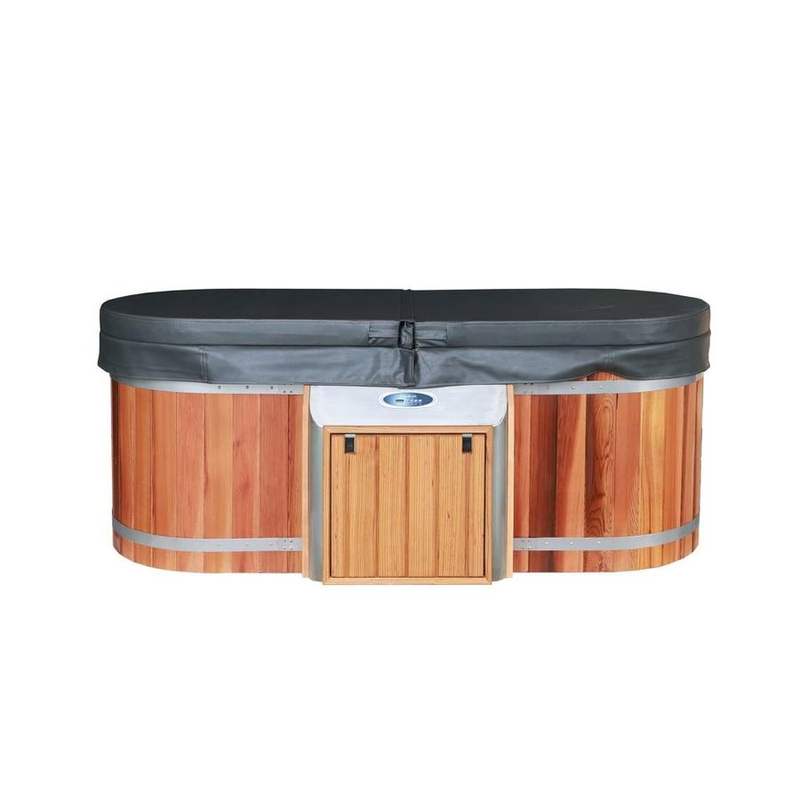
Forget “slow and steady wins the race”, especially when your race is to “soaking in a hot tub, stat!”
Introducing the Pocket Rocket Electric Outdoor Bath, because who has time to watch water heat up anymore? Once heated, she stays at temp. This little dynamo is like a caffeinated bathtub, going from “polar bear plunge” to “tropical paradise” faster than you can say “where's my rubber ducky?”
Perfect for Airbnb hosts who want five-star reviews (and to avoid guest mutinies), or anyone who's ever yelled at a kettle for being too slow. Crafted with marine-grade 316 stainless and beautiful red Canadian cedar, this compact wonder fits practically anywhere, meaning even your postage-stamp-sized backyard can become a spa-worthy retreat.
We only use the best electronics in our tubs: the SpaNET control system from Australia, because when it comes to bathtubs, we don't mess around.
So ditch the waiting game and dive into the Pocket Rocket. It's the fastest way to turn your backyard into a relaxation zone, without needing a degree in thermodynamics. Just plug it in, hop in, and let the good times roll. Rapidly.
Running it as an Airbnb?
Guest turnover is a different game from a family tub, and there's one thing worth understanding before your first booking. This tub runs ozone, which is superb at oxidising what guests leave behind, but ozone is a secondary sanitiser. It holds no residual and disappears within seconds, so it cannot keep water safe between soaks on its own. It needs a primary sanitiser underneath it.
For 316 stainless that means chlorine, kept deliberately light: sodium dichlor at around 3 ppm with pH near 7.5. Five ppm is the ceiling. Above it you start eating into the chromium oxide layer that makes the steel stainless. Test it, don't guess it. Any pool shop in the country stocks it. Perfect Pools do a 1 kg pail for about $20 and ship nationwide. Ask for spa chlorine, never pool chlorine: trichlor and cal-hypo are the wrong chemistry and the acidity pits stainless. Want to use less again? A Nature2 mineral stick in the filter housing (about $105, four months) cuts how much chlorine the water needs.
Chlorine is the one that plays nicely with an ozonator. It's what these systems are designed around, and it does the cell no harm at all. Three things we'd steer you away from. Bromine, which is specifically not recommended alongside ozone in a commercial spa, because ozone and bromide together make bromate. Chlorine-free biguanide (PHMB) systems, genuinely lovely in a tub with no ozonator, but corona-discharge ozone destroys the PHMB itself, so you'd be dosing a sanitiser that isn't there any more. And salt chlorinators, because the chloride load is hard on steel.
Look after the ozonator and it'll look after you. What kills them is plumbing, not chemistry: a check valve that sticks and lets water back up into the cell, or the clear ozone hose going yellow and brittle and splitting. Eyeball both once a year. The cell itself is a consumable, roughly two to three years on a UV lamp, three to five on a corona-discharge chip. So budget for it rather than be surprised by it.
Clean the cartridge weekly under guest use, not monthly, and keep a spare. Spas run commercially also pick up council water-quality obligations in most districts. Worth a phone call before your first booking.
We've put the lot in one place: Water Care for Short-Stay Operators (PDF), targets, dosing, the weekly routine, what not to use, and how to look after the ozone unit. Print it and stick it on the plant-room wall. Still stuck? Email us.